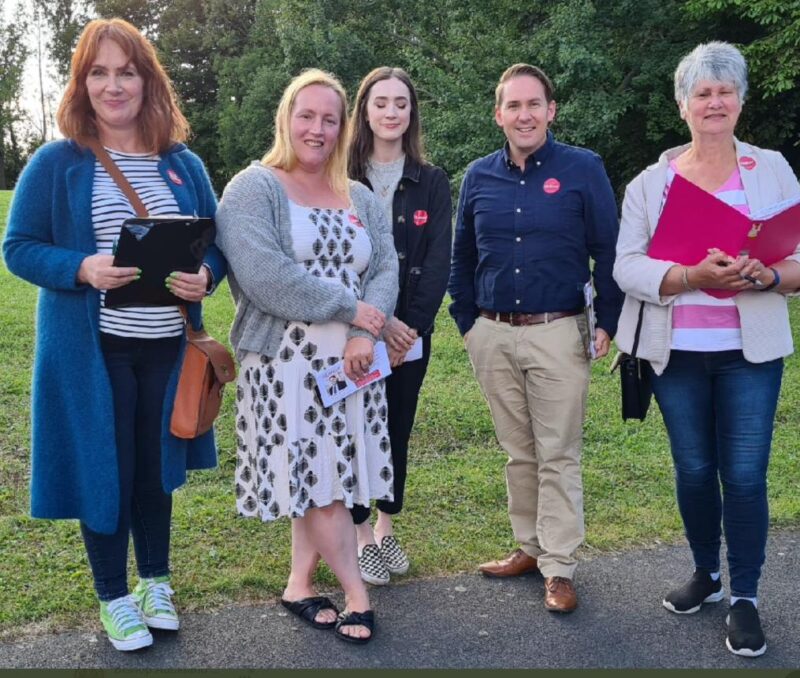
Bishop Auckland is a constituency in County Durham that is represented in the House of Commons since 2024 by Sam Rushworth of the Labour Party.
Constituency profile
The constituency is located in an upland, western part of County Durham in the North East of England.
The constituency includes as its major settlements the towns of Barnard Castle, Bishop Auckland, Shildon, Middleton-in-Teesdale, Crook, Tow Law, Stanhope and Wolsingham, with their surrounding villages, dales and fields. The seat is named for the market town of Bishop Auckland which has a mixed modern and historic high street. It also includes the similarly sized Barnard Castle, together with large areas used for agriculture, particularly hill farming on the rolling landscape that cuts into the Pennines, with a substantial quantity of livestock. Most housing, many small towns and most facilities were built in the prosperous era of coal mining which brought thousands of workers to live in Bishop Auckland town and neighbouring settlements. Manufacturing, including food processing and packaging, public sector employment, retail and agriculture are the main employers.
Within the seat are Auckland Castle and Park, Lartington Hall, Witton Castle, Raby Castle, Binchester Roman Fort (Vinovia), The Bowes Museum, the Weardale Railway and enclosures and industrial workings on Cockfield Fell.
History
From 1935 to 2017 inclusive, the seat's voters returned MPs from the Labour Party; the former Labour Chancellor of the Exchequer Hugh Dalton, was the MP for Bishop Auckland from 1929 to 1931, and after regaining the seat in 1935, remained an MP until 1959. The 2019 result returned a Conservative; the party's results had shown an increase from election to election from 2001 onwards, going from 20% of the vote in the previous 1997 election to a majority of votes at 53% in 2019. However, this was reversed in 2024 when the Conservative vote dropped back down to 25.6% and Labour regained the seat.
Boundaries
1885–1918
- Part of the Sessional Division of Bishop Auckland.
The constituency was created for the 1885 general election by the Redistribution of Seats Act 1885 as one of eight new single-member divisions of the county of Durham, replacing the two 2-member seats of North Durham and South Durham. See map on Vision of Britain website.
1918–1950
- The Urban Districts of Bishop Auckland and Shildon; and
- part of the Rural District of Auckland.
Gained parts of Barnard Castle, offset by losses to the new constituencies of Sedgefield and Spennymoor.
1950–1955
- The Urban Districts of Barnard Castle, Bishop Auckland, and Shildon; and
- the Rural District of Barnard Castle.
The urban and rural districts of Barnard Castle transferred from the abolished constituency thereof.
1955–1974
As above, except the part of the Middridge ward transferred to the Rural District of Darlington by the County of Durham (Parish of Great Aycliffe) Confirmation Order 1952 (Statutory Instrument 1953/741).
1974–1983
- The Urban Districts of Barnard Castle, Bishop Auckland, and Shildon; and
- the Rural Districts of Barnard Castle and Darlington.
Gained the rural district of Darlington (which contained the new town of Newton Aycliffe) from the abolished constituency of Sedgefield.
1983–1997
- The District of Wear Valley wards of Bishop Auckland Town, Cockton Hill, Coundon, Coundon Grange, Escomb, Henknowle, St Helen's, West Auckland, and Woodhouse Close;
- the District of Teesdale; and
- the District of Sedgefield wards of Byerley, Middridge, Neville, Shafto, Simpasture, Sunnydale, Thickley, West, and Woodham.
Rural areas around Darlington returned to the re-established Sedgefield constituency.
1997–2024
- The District of Wear Valley wards of Bishop Auckland Town, Cockton Hill, Coundon, Coundon Grange, Escomb, Henknowle, St Helen's, West Auckland, and Woodhouse Close;
- the District of Teesdale; and
- the District of Sedgefield wards of Byerley, Low Spennymoor and Tudhoe Grange, Middlestone, Spennymoor, Sunnydale, Thickley, and Tudhoe.
Gained Spennymoor from Sedgefield in exchange for Newton Aycliffe.
Following a review of parliamentary representation in County Durham in 2007, the Boundary Commission for England made no changes to the Bishop Auckland constituency. In the 2009 structural changes to local government in England, the local authority districts in Durham were abolished and replaced with a single unitary authority; however, this did not affect the boundaries of the constituency.
2024–present
Following the 2023 periodic review of Westminster constituencies, enacted by the Parliamentary Constituencies Order 2023, from the 2024 general election, the constituency is composed of the following electoral divisions of the County of Durham (as they existed on 1 December 2020):
- Barnard Castle East; Barnard Castle West; Bishop Auckland Town; Coundon; Crook; Evenwood; Shildon and Dene Valley; Tow Law; Weardale; West Auckland; Woodhouse Close.
The constituency experienced significant boundary changes with, Spennymoor and Tudhoe being transferred to the new constituency of Newton Aycliffe and Spennymoor, and Crook, Tow Law and Weardale being added from the abolished constituency of North West Durham.
Members of Parliament
Elections
Elections in the 2020s
Elections in the 2010s
Elections in the 2000s
Elections in the 1990s
Elections in the 1980s
Elections in the 1970s
Elections in the 1960s
Elections in the 1950s
Elections in the 1940s
Elections in the 1930s
Elections in the 1920s
Elections in the 1910s
General Election 1914–15: Another General Election was required to take place before the end of 1915. The political parties had been making preparations for an election to take place and by July 1914, the following candidates had been selected;
- Liberal: Vickerman Rutherford
- Unionist: Richard George Tyndall Bright
- Labour: Ben Spoor
Elections in the 1900s
Elections in the 1890s
Elections in the 1880s
See also
- List of parliamentary constituencies in County Durham
- List of parliamentary constituencies in North East England (region)
- History of parliamentary constituencies and boundaries in Durham
- Bishop Auckland by-election, 1929
Notes
References
Sources
- Craig, F. W. S. (1983) [1969]. British parliamentary election results 1918–1949 (3rd ed.). Chichester: Parliamentary Research Services. ISBN 0-900178-06-X.
External links
- Bishop Auckland UK Parliament constituency (boundaries April 1997 – April 2010) at MapIt UK
- Bishop Auckland UK Parliament constituency (boundaries April 2010 – May 2024) at MapIt UK
- Bishop Auckland UK Parliament constituency (boundaries from June 2024) at MapIt UK